


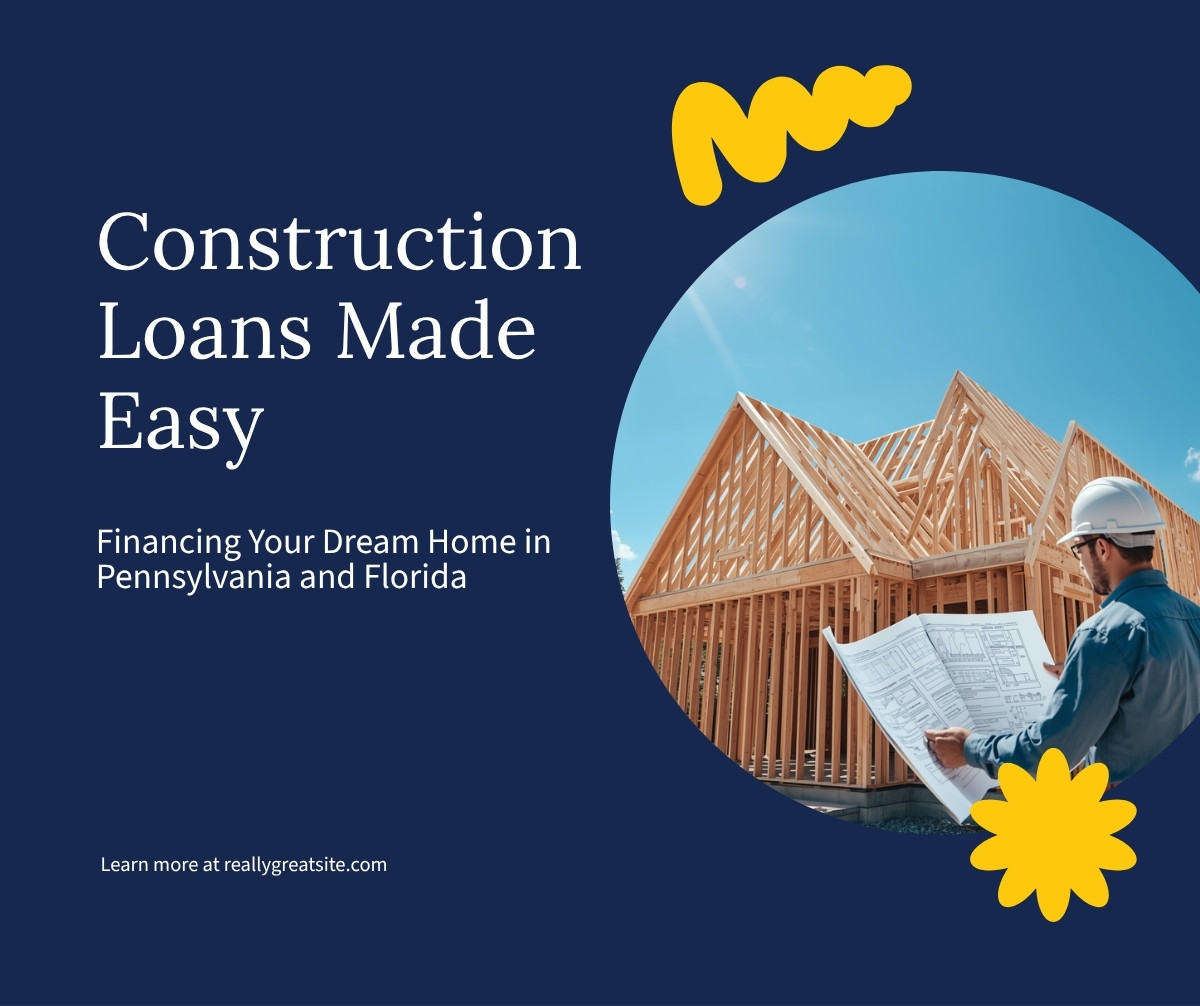
Construction Loans in Pennsylvania and Florida, How to Finance Building a New Home in 2026
construction loan Pennsylvania Florida, I have financed new construction for buyers across both Pennsylvania and Florida for years, and the single biggest mistake I see is people signing a contract with a builder before they understand how a construction loan works. Building a home is not like buying one. The financing is structured differently, the timeline is longer, the risks are real, and if you walk in unprepared, it gets expensive fast.
This guide covers everything you need to know about getting a construction loan in Pennsylvania and Florida in 2026, from loan types and draw schedules to builder vetting and what happens when costs run over budget. Dynamic Funding Solutions specializes in construction loan pennsylvania florida for borrowers throughout Pennsylvania and Florida.
Why Construction Loans Are Different from Traditional Mortgages
A standard mortgage funds an existing property. The house is there. The appraiser walks through it. The lender knows exactly what they are financing.
A construction loan funds a house that does not exist yet.
That changes everything. The lender is taking on risk that the home may never be completed, that the builder may walk off the job, that costs may spiral, that the finished product may appraise below what was spent. Because of that added risk, construction loans carry stricter qualification requirements, higher interest rates during the build phase, and a more hands-on process for everyone involved.
Here in Bucks County, I work with buyers looking at buildable lots in Perkasie, Quakertown, and Chalfont, areas where you can still find half-acre and acre parcels at reasonable prices. Chester County has similar pockets around Harleysville and the western edges. On the Florida side, Port St. Lucie and the western communities around Palm Beach Gardens have been active new construction zones for years. And in Cape Coral and Fort Myers, post-Hurricane Ian rebuilding has created enormous demand for construction financing, homeowners replacing destroyed properties, investors building spec homes, and families starting over.
Whether you are building on raw land in rural Quakertown or putting up a concrete-block home in Cape Coral’s flood zone, the financing mechanics are the same. The details differ by property type and location, but the loan structure follows the same framework.
The Two Main Types: Construction-to-Permanent vs. Construction-Only
Every construction loan falls into one of two categories. Picking the right one affects your closing costs, your rate, and how much paperwork you deal with.
Construction-to-permanent (single close) is one loan that covers both the build period and the permanent mortgage. You close once. During construction, you make interest-only payments on whatever amount has been drawn. When the builder finishes and the home passes final inspection, the loan automatically converts to a standard 15- or 30-year mortgage at the rate you locked when you closed.
The advantage is straightforward: one set of closing costs, one qualification, one appraisal process. The rate is locked before the first shovel hits dirt.
Construction-only (two-close) is two separate loans. The first loan covers only the build period, typically 9 to 12 months. When construction is done, you pay off that loan by closing on a separate permanent mortgage. That means two appraisals, two sets of closing costs, and two rounds of underwriting.
Why would anyone choose the two-close option? Flexibility. If you think rates will drop during your build period, you might prefer to lock your permanent rate later. Some borrowers also use the two-close structure when they are building on land they already own and want to keep the construction financing separate.
| Feature | Construction-to-Permanent (Single Close) | Construction-Only (Two Close) |
|---|---|---|
| Number of closings | 1 | 2 |
| Closing costs | One set | Two sets (construction + permanent) |
| Rate lock timing | Locked at initial close | Permanent rate locked at second close |
| Interest during build | Interest-only on drawn amount | Interest-only on drawn amount |
| Qualification rounds | 1 | 2 (must re-qualify for permanent loan) |
| Best for | Rate certainty, lower total costs | Flexibility on permanent loan terms |
| Risk | Locked into terms set before build | Must re-qualify, credit or income changes could be a problem |
For most buyers I work with, the single-close option wins. Two closings means roughly $4,000 to $8,000 in additional fees depending on loan size, and the re-qualification risk is real, if your credit score drops 23 points during the build because you took on a car payment, your permanent rate could jump or the loan could fall apart entirely.
How Construction Draws Work
This is the part that confuses people most.
When you close on a construction loan, the lender does not hand your builder a check for $487,000. The funds are released in stages called draws, and each draw requires verification that the work has actually been completed.
A typical draw schedule has four to six stages:
- Foundation and site work, lot clearing, excavation, foundation pour
- Framing, structural framing, roof sheathing, windows and exterior doors
- Mechanical rough-in, plumbing, electrical, HVAC ductwork
- Interior finishing, drywall, cabinets, flooring, fixtures
- Final completion, landscaping, driveway, punch list items, certificate of occupancy
Before each draw, the lender sends a third-party inspector to the site. The inspector verifies that the stage is complete, takes photos, and submits a report. Only after the lender reviews and approves that report does the next draw get released.
During the draw period, you pay interest only on the amount that has been disbursed. If your total construction loan is $450,000 and only $112,000 has been drawn after the foundation stage, you are paying interest on $112,000. That keeps your monthly payments lower during the early months.
One thing buyers in Horsham and Lansdale should know: if you are buying in a new construction community where the builder controls the timeline, the draw process may be handled differently than a custom build on your own lot. Production builders in developments along Route 309 and in North Wales often use their own financing structures and may push buyers toward their preferred lenders. That does not mean you have to use them. Getting your own construction loan and comparing terms can save you thousands.
The Contingency Reserve: Your Financial Safety Net
Every construction lender requires a contingency reserve built into the budget, typically 10% to 15% of total construction costs. This is not optional.
The reserve exists because construction always costs more than the estimate. Always. Lumber prices spike. The excavation reveals rock that needs blasting. The municipality requires an upgraded septic system. Your tile supplier is backordered and the replacement costs $3.40 more per square foot.
On a $500,000 build, a 10% contingency means $50,000 set aside for overruns. That money sits in the loan and only gets drawn if needed. If your build comes in under budget, which happens occasionally but do not count on it, the unused contingency reduces your final loan balance.
In Cape Coral and the Fort Myers area, contingency is even more critical. Post-Ian rebuilding has driven up contractor and material costs across Lee and Charlotte counties. Concrete block, impact windows, and roofing labor are all running 12-18% above pre-storm prices as of early 2026. If you are building in southwest Florida right now, I would push for the full 15% contingency without hesitation.
Land Ownership and Its Role in Your Down Payment
If you already own the lot where you plan to build, you have a significant advantage.
Most construction lenders will count the appraised value of your land as equity toward the down payment requirement. If the lot appraises at $125,000 and your total project cost (land plus construction) is $625,000, that lot represents 20% equity right out of the gate. You might not need any additional cash down.
Even if you still owe on the land, say you bought the lot with a land loan and have a $67,000 balance, the lender will factor in your existing equity. If the lot is worth $125,000 and you owe $67,000, you have $58,000 in equity to apply.
This matters a lot in areas like Buckingham Township and the outer edges of Bucks County, where families buy a 2-acre parcel years before they are ready to build. That foresight pays off when it is time to finance construction.
In Florida, the same principle applies in the developing western communities around Palm Beach Gardens and in the Riviera Beach redevelopment corridor, where lot purchases have been running ahead of construction starts.
Builder Approval: The Step Most Buyers Do Not Expect
Here is something that catches nearly every first-time construction borrower off guard: the lender does not just qualify you. They qualify your builder.
Before approving a construction loan, the lender will vet the general contractor or builder. This typically includes:
- Verification of active state contractor license (Pennsylvania requires registration with the Attorney General; Florida requires a state-issued contractor license through DBPR)
- Proof of general liability insurance and workers’ compensation coverage
- Financial references or a financial statement from the builder
- A track record of completed projects, most lenders want to see 3 to 5 completed builds minimum
- Review of the construction contract, plans, and specifications
You cannot just hire your neighbor’s cousin who does great tile work. The builder has to be established, insured, and financially stable enough that the lender trusts them to finish the project.
In practice, this means you should have a conversation with a lender before you commit to a builder. I have seen buyers sign contracts with builders who cannot pass lender vetting, and unwinding those contracts costs time and sometimes money, especially if a deposit has already been paid.
Timeline and Rate Structure During the Build
A standard construction loan has a build period of 9 to 12 months. Some lenders allow extensions to 18 months for complex custom builds, but that often comes with a fee.
During the build period, the rate is typically variable, often tied to the prime rate plus a margin. As of early 2026, that puts construction period rates in the range of 7.75% to 9.25% depending on the lender and borrower profile.
Remember, you are only paying interest on the drawn amount, so the effective monthly payment during early construction is much lower than it will be once the full amount is disbursed.
With a construction-to-permanent loan, the permanent rate is locked at closing. With a two-close structure, you will lock the permanent rate when you close on the takeout mortgage after the build is done.
VA Construction Loans: Available but Complex
Veterans and active-duty service members can use VA loans for new construction, but it is worth knowing upfront that VA construction loans are rare. Very few lenders offer them, the requirements are stringent, and the process is slower.
If you are VA-eligible and want to build, it is possible. But expect a longer search for a lender, more documentation, and potentially a two-close structure where you use a conventional construction loan for the build phase and refinance into a VA loan after completion. Contact me directly if this applies to you, I can walk you through the options.
The Biggest Risk: Cost Overruns
I mentioned contingency reserves earlier, and this is why they matter.
Cost overruns are the number one cause of construction loan problems. When total costs exceed the approved loan amount plus contingency, the lender will not simply increase the loan. You are on the hook for the difference.
This can happen for a dozen reasons: material price increases mid-build, change orders (you decided to upgrade the kitchen after framing was done), site conditions that were not caught in the soil test, permit delays that extend the build timeline and add carrying costs.
The fix is prevention. Get detailed, itemized bids from your builder. Lock material costs where possible. Minimize change orders after construction starts. And build that full contingency reserve into the loan from day one.
Where Construction Loans Make Sense Right Now
In Pennsylvania, the opportunity is strongest in areas where buildable lots still exist at reasonable prices. Perkasie, Quakertown, Chalfont, and Harleysville all have parcels available. The new construction communities along the Lansdale-Horsham-North Wales corridor give buyers the option to compare a custom build on their own lot versus a production builder’s package deal.
In Florida, Port St. Lucie continues to be one of the most active new construction markets on the Treasure Coast. Western Palm Beach Gardens and the communities around the Beeline Highway have new development pushing west. And the Lee County market, Cape Coral, Fort Myers, and Lehigh Acres, is in the middle of a multi-year rebuild cycle that will continue through 2027 at minimum.
Talk Through Your Build Plan Before You Sign with a Builder
If you are thinking about building, the smartest move is a 15-minute conversation before you sign anything. I can tell you what you qualify for, which loan structure makes sense for your situation, and whether your builder will pass lender vetting, all before you commit a dollar.
Book a free 15-minute strategy call: https://calendly.com/lpolnet71/strategy_15min
Or call directly, PA: (215) 364-7171 | FL: (561) 247-4888
Dynamic Funding Solutions | NMLS #17144 | Lena Polnet NMLS #17225 | Licensed in Pennsylvania and Florida | This content is for informational purposes only and does not constitute a commitment to lend. Loan approval is subject to credit, income, and property qualification.
Key Entities
- Construction Loan (Wikidata: Q5164164), Short-term financing used to fund the building of a new home or structure. Wikidata | Wikipedia
- Bucks County, Pennsylvania (Wikidata: Q156357), County northeast of Philadelphia with active new construction markets in Perkasie, Quakertown, and Chalfont. Wikidata
- Cape Coral, Florida (Wikidata: Q498785), Southwest Florida city with high construction loan demand due to post-Hurricane Ian rebuilding. Wikidata
- VA Loan (Wikidata: Q7908848), U.S. Department of Veterans Affairs mortgage benefit available for construction in limited programs. Wikidata
Resources
Topic Info
Construction loans in Pennsylvania and Florida fund homes that do not yet exist, making them structurally different from traditional mortgages. Key decisions include single-close vs. two-close structure, draw schedule management, builder vetting requirements, and contingency reserves (10-15%). Active markets include Bucks County PA, Port St. Lucie FL, and the Lee County post-Ian rebuild zone.
Frequently Asked Questions
What is the difference between a construction-to-permanent and construction-only loan?
A construction-to-permanent loan (single-close) covers both the build period and permanent mortgage in one closing, one set of costs, one qualification, rate locked before construction starts. A construction-only loan (two-close) requires two separate closings and two rounds of underwriting: one for the build phase and one for the permanent mortgage. Single-close is usually better for cost and rate certainty; two-close offers flexibility if you expect rates to drop during construction.
How do construction loan draws work?
Construction loan funds are released in stages called draws, typically 4 to 6 stages covering foundation, framing, mechanical rough-in, interior finishing, and final completion. Before each draw, the lender sends a third-party inspector to verify the work is complete. You pay interest only on the amount disbursed, so payments are lower in early stages when less has been drawn.
Does the lender verify my builder before approving a construction loan?
Yes, lenders qualify the builder as well as the borrower. They verify the builder’s active state contractor license (Pennsylvania: Attorney General registration; Florida: DBPR license), general liability and workers’ compensation insurance, financial stability, and a track record of 3-5+ completed projects. Sign a builder contract only after confirming the builder can pass lender vetting.
Can existing land equity count toward my down payment?
Yes. Most construction lenders count the appraised value of land you already own as equity toward the down payment requirement. If your lot appraises at $125,000 on a $625,000 total project, that’s 20% equity, potentially eliminating the need for additional cash down. Even if you owe on the land, existing equity in the lot applies toward the required contribution.
Why is a contingency reserve required and how large should it be?
Construction lenders require a contingency reserve, typically 10-15% of total build costs, because construction almost always costs more than the estimate. Lumber price spikes, unexpected site conditions, permit delays, and change orders all drive costs above budget. In Cape Coral and Fort Myers (post-Ian rebuild zone), 15% is recommended due to elevated contractor and material costs running 12-18% above pre-storm levels as of 2026.
Ready to explore your mortgage options? Contact Dynamic Funding Solutions today or view all our loan programs to find the right fit for your situation. Our licensed mortgage professionals serve borrowers throughout Pennsylvania and Florida.