



Running a business in Pennsylvania means juggling payroll, inventory, slow-paying clients, and unexpected expenses all at once. A business line of credit can give you a financial cushion that keeps cash flowing when timing works against you. But before you walk into a bank or fill out an online form, it helps to understand how a business line of credit actually works, what lenders look at when you apply, and how your personal financial picture, including your home equity, fits into the bigger funding picture.
At Dynamic Funding Solutions, we work with business owners every day. Our focus is mortgage lending in Pennsylvania and Florida, but that means we spend a lot of time talking with self-employed borrowers, independent contractors, and real estate investors about how their business finances interact with their personal borrowing power. If you own a business and you are thinking about a line of credit, reading this first could save you time, money, and a few headaches.
What Is a Business Line of Credit?
A business line of credit is a revolving credit facility that lets a company draw funds up to a set limit, repay what it borrowed, and draw again. Unlike a term loan, where you receive a lump sum and pay it down over a fixed schedule, a line of credit is flexible. You only pay interest on the amount you actually use.
Businesses use lines of credit for a wide range of purposes:
- Covering payroll during a slow month
- Buying inventory ahead of a busy season
- Bridging the gap when a large invoice has not been paid yet
- Handling emergency repairs or equipment replacement
- Taking advantage of a time-sensitive opportunity without draining cash reserves
Lines of credit come in two basic forms: secured and unsecured. A secured line requires collateral, often real estate, equipment, or accounts receivable. An unsecured line relies entirely on your creditworthiness and business financials. Secured lines typically come with lower interest rates and higher credit limits because the lender has something to recover if things go wrong.
How Business Lines of Credit Are Different From Business Loans
The difference matters more than it might seem. A term loan gives you predictability. You know exactly what you owe each month and when the debt will be retired. A line of credit gives you flexibility, but it also requires more discipline. Because you can keep drawing on it, some business owners find themselves carrying a balance they never fully pay down.
From a lender’s perspective, a revolving line of credit is also evaluated differently than a term loan. Banks and commercial lenders look closely at your business cash flow, not just your credit score. They want to see that revenue is consistent enough to support repayments even when you draw the full amount. For businesses with irregular income, which includes a lot of self-employed owners and contractors, that consistency can be hard to document in the way a traditional lender expects.
This is one reason many Pennsylvania business owners explore home-equity-backed financing alongside or instead of a business line of credit. If you have built equity in your home, that asset can sometimes work harder for you than a purely business-based credit line.
What Pennsylvania Lenders Look at When You Apply
Whether you apply through a bank, a credit union, or an online commercial lender, the underwriting criteria follow a similar framework. Understanding these criteria ahead of time lets you address weaknesses before they become rejections.
Time in business. Most traditional lenders want to see at least two years of operating history. Newer businesses are considered higher risk. Some alternative lenders will work with businesses that have been operating for six months or more, but expect tighter terms.
Annual revenue. Lenders set minimum revenue thresholds. The higher your revenue and the more consistent it is, the more favorable your terms will likely be.
Personal credit score. For small businesses, the owner’s personal credit score is almost always part of the equation, especially if the business has not established its own credit profile. A strong personal score signals responsible financial behavior. If your score needs work, our page on improving your credit score for mortgage approval in Pennsylvania covers principles that apply across many types of lending, not just mortgages.
Business credit profile. Your business may have its own credit file through Dun and Bradstreet, Experian Business, or Equifax Business. Paying vendors and suppliers on time helps build this profile over time.
Cash flow documentation. Banks typically ask for two to three years of business tax returns, profit and loss statements, and recent bank statements. If your tax returns show modest income because of aggressive deductions, a traditional lender may see your business as less profitable than it really is. This is a problem we see constantly with self-employed borrowers.
Collateral. For secured lines, lenders assess the value and liquidity of what you are pledging. Real estate is generally the most accepted form of collateral because it holds value and can be sold.
The Self-Employed Borrower Problem
Here is something a lot of business owners do not realize until they are sitting across from a loan officer: the same tax strategy that reduces your business’s taxable income can also make it much harder to qualify for credit.
When you write off vehicle expenses, home office costs, depreciation, meals, and other legitimate deductions, your net income on paper drops. That is exactly what those deductions are designed to do from a tax standpoint. But lenders who rely on tax returns to verify income see a business that earns less than it actually brings in.
This is why bank statement loan programs exist. Instead of tax returns, these programs use twelve to twenty-four months of business or personal bank statements to calculate average monthly deposits. The actual cash flowing through your accounts tells a more accurate story of what your business earns and can support.
At Dynamic Funding Solutions, this is exactly the kind of borrower we focus on. If you are self-employed and you have been turned away by a bank because your tax returns do not reflect your true income, there are mortgage and home equity programs built specifically for your situation. Our home loan options for Pennsylvania business owners page explains how these programs work in detail.
Many business owners in Pennsylvania also operate as 1099 contractors. If that describes you, take a look at our resources on 1099 contractor mortgages in Pennsylvania and 1099 mortgage programs for more on how your income can be documented and used to qualify.
How Far SBA-Backed Financing Can Go
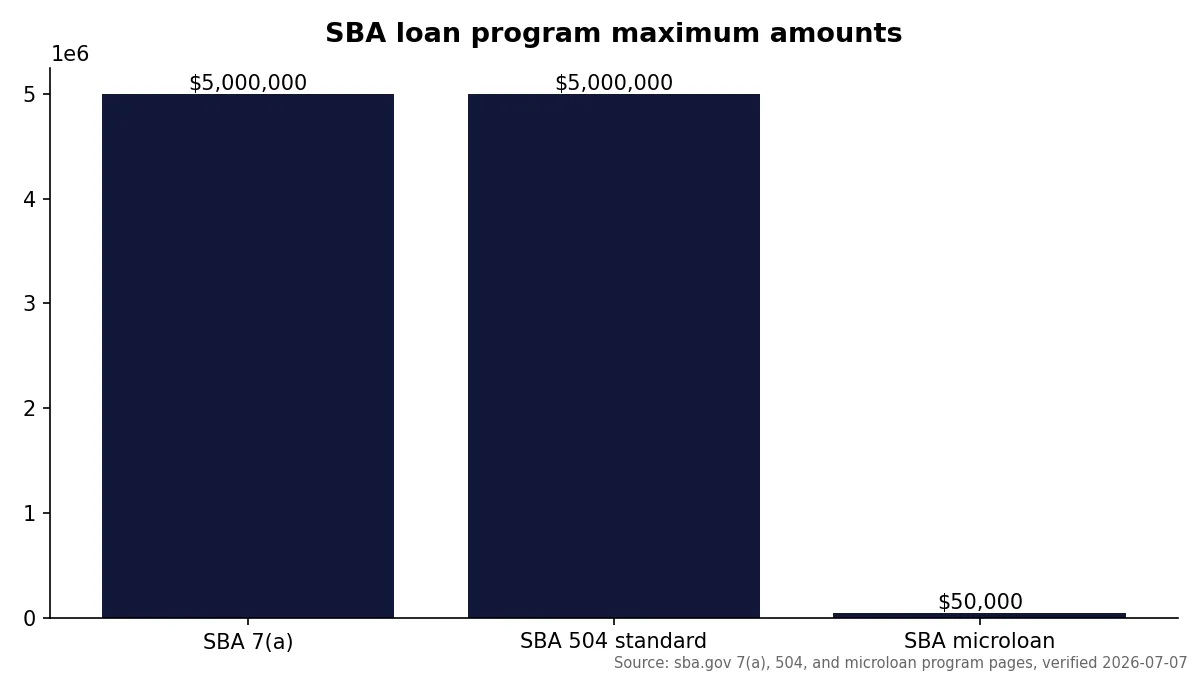
Alongside bank and home-equity options, the U.S. Small Business Administration guarantees loan programs through participating lenders. The scale ranges widely: SBA microloans top out at $50,000, while 7(a) loans and standard 504 loans reach up to $5,000,000 [sba.gov program pages, verified 2026-07-07]. Knowing where your funding need falls on that range helps you pick the right conversation to start.
Using Home Equity as a Business Funding Tool
Pennsylvania homeowners who have built equity in their property have an asset that can do real work for their business. A home equity line of credit, commonly called a HELOC, operates similarly to a business line of credit but is secured by your home. Because of that security, interest rates tend to be lower than unsecured business lines, and the qualification process often looks at your overall financial picture rather than just your business metrics.
A cash-out refinance is another option. You refinance your existing mortgage for more than you owe, take the difference in cash, and use those funds however you need. This gives you a lump sum rather than a revolving line, but the interest rate is typically fixed and the payment is predictable.
Both options have tradeoffs. Pledging your home as collateral means your personal residence is at risk if the business runs into trouble. That is a decision that deserves careful thought and honest conversation with your lender. It is not the right move for every situation, but for business owners with solid equity and a clear plan for the funds, it can be one of the most cost-effective ways to access capital.
If you are considering a refinance to pull out equity for business purposes, understanding the difference between loan structures matters. Our comparison of 15-year versus 30-year mortgage options in Pennsylvania can help you think through the payment implications, and our explanation of adjustable-rate mortgages in Pennsylvania covers another structure worth knowing about.
Why Working With a Local, Owner-Operated Lender Matters
Dynamic Funding Solutions is an owner-operated mortgage lender based in Huntingdon Valley, Pennsylvania. We serve clients across Pennsylvania and Florida. When you work with us, you talk directly with the people who are actually handling your loan. There is no call center, no loan officer handing you off to a processor you have never spoken with, and no corporate chain of command slowing down your answers.
For business owners specifically, that direct relationship matters. Your financial situation is almost certainly more complex than a salaried employee’s. You may have multiple income streams, seasonal revenue patterns, business debt that affects your personal debt-to-income ratio, and a tax return that does not tell the whole story. Explaining that complexity to a call center representative who has never met you and is following a script is frustrating and often unproductive.
When you sit down with us, we take the time to understand your full picture. We have worked with contractors, real estate investors, small business owners, and self-employed professionals across Pennsylvania. That experience means we know which loan programs are most likely to work for your situation before we start the paperwork.
The Pennsylvania Mortgage Credit Certificate program is one example of a benefit many business-owner borrowers overlook. If you qualify as a first-time homebuyer, this program can provide a federal tax credit on a portion of the mortgage interest you pay each year, which puts real money back in your pocket annually.
Our Experience With Business Owners and Complex Borrowers
Dynamic Funding Solutions has spent years working specifically with borrowers whose income does not fit the standard W-2 mold. Self-employed professionals, independent contractors, real estate investors, and small business owners make up a large share of the clients we serve. We understand how business financials interact with personal mortgage qualification, how bank statement programs work in practice, and how to structure a loan application that gives an underwriter what they need to say yes.
Our office is in Huntingdon Valley, in Bucks County, Pennsylvania. We know this market. We know the types of borrowers who live and work here, the kinds of businesses they run, and the financial challenges that come with running a company while also owning or trying to buy a home. That on-the-ground experience, combined with access to a wide range of loan programs, is what we bring to every client conversation.
We are not a large institution with standardized workflows. We are a focused team that handles each file with attention to detail and direct communication. If you have been turned down before or told your income is too complicated, that is often the situation where we can help the most.
Frequently Asked Questions
Can I use a mortgage or home equity product to fund my business instead of a traditional business line of credit?
Yes, many Pennsylvania business owners do exactly this. A HELOC or cash-out refinance uses the equity in your home as collateral, which often results in lower interest rates than an unsecured business line. The tradeoff is that your home is on the line if repayment becomes a problem. Whether this makes sense depends on your equity, your cash flow, and how the funds will be used. Talking with a lender who understands both the mortgage and the business side of the equation helps you make a more informed decision.
My business tax returns show low income because of deductions. Will that hurt my chances of getting approved?
It can hurt you with lenders who rely exclusively on tax returns to verify income. However, bank statement loan programs are specifically designed for this situation. These programs analyze your actual deposit history, usually over twelve to twenty-four months, to calculate your qualifying income rather than relying on what the tax return shows after deductions. Many self-employed borrowers qualify for more than they expect once the right program is used.
Does Pennsylvania have any programs that help small business owners with financing?
Yes. The Pennsylvania Small Business Development Centers and the U.S. Small Business Administration both offer resources, counseling, and loan programs for Pennsylvania business owners. The SBA’s guaranteed loan programs, for example, can make it easier for small businesses to qualify for financing through participating lenders. These programs work alongside, not instead of, your personal financial strategy, so it is worth exploring both paths at the same time.
How does my personal credit score affect my ability to get a business line of credit?
For most small businesses, especially sole proprietorships and single-member LLCs, the owner’s personal credit score is a major factor in business credit decisions. Lenders view it as a direct signal of how the owner manages financial obligations. A score that needs improvement can limit your options or result in higher interest rates. Working to improve your personal score before applying, by reducing balances, correcting errors, and making on-time payments, can meaningfully improve what you qualify for.
I am both a homeowner and a business owner. How do lenders evaluate my overall financial picture?
Lenders look at the full picture, which includes your business income, personal income, existing debts (both personal and any business debts you have personally guaranteed), credit history, and assets. For mortgage purposes, your debt-to-income ratio is a key calculation. Business expenses, outstanding loans, and even a business line of credit you have drawn on can all affect that ratio. Working with a lender who regularly handles self-employed and business-owner borrowers helps because they know how to document and present your income in the way that gives you the best chance of approval.
If you are a Pennsylvania business owner thinking about a business line of credit, home equity financing, or a mortgage that fits your self-employed income, we would like to talk with you. Dynamic Funding Solutions works directly with borrowers in situations just like yours. Call us at (215) 364-7171 or reach us through dynamicfunding.net to start a conversation with our team in Huntingdon Valley. We will look at your full picture, explain your options honestly, and help you figure out what actually makes sense for where you are right now.