


Reviewed by Lena Polnet, NMLS #17225, owner of Dynamic Funding Solutions, Inc. (NMLS #17144)
If you are buying a home in Pennsylvania or Florida, your loan officer will mention a “commitment letter” at some point, usually a few weeks after your offer is accepted. It is one of those terms that gets tossed around without much explanation, yet it decides whether your purchase actually closes on time. Knowing what a mortgage commitment letter is, how it differs from the other paperwork in your loan file, and why sellers and agents watch for it can save you a lot of confusion during an already busy stretch.
At Dynamic Funding Solutions, we work with buyers across Pennsylvania and Florida, including self-employed borrowers and real estate investors whose income does not fit neatly into a bank’s standard checkboxes. For those borrowers, the commitment letter is often the moment they finally exhale, because it means an underwriter has looked past the surface and approved the loan. Here is what you need to know.
What a Mortgage Commitment Letter Is
A mortgage commitment letter is a written statement from your lender that your loan has been underwritten and approved, usually subject to a short list of conditions. It is not a preapproval, and it is not a guarantee that nothing can change. It is the lender’s written commitment to fund your loan as long as the conditions in the letter are met and your finances stay the same between now and closing.
The Consumer Financial Protection Bureau describes it this way: some lenders “may issue a written commitment letter valid for a certain period of time to extend a loan up to a specified amount subject to limited conditions” (CFPB, prequalification versus preapproval). Two parts of that sentence matter: the letter has an expiration date, and it lists conditions.
What the letter usually includes
- The loan amount and loan program (conventional, FHA, VA, bank statement, DSCR, and so on)
- The interest rate, or a note that the rate is not yet locked
- The property address
- An expiration date for the commitment
- Any remaining conditions the underwriter needs before the file is clear to close
Once this letter is in hand, you are much closer to the finish line than you were at preapproval or during the appraisal.
How a Commitment Letter Differs From a Preapproval
Buyers mix these two up all the time, but they come from very different stages of the loan.
Preapproval comes before you have a house
A preapproval letter is issued early, based on a review of your credit, income, and assets, usually before you have found a property. It tells sellers you are likely to qualify up to a certain amount. It has not looked at the specific home, the appraisal, or the title.
The commitment comes after underwriting reviews the actual property
A commitment letter comes later, after you are under contract, the appraisal is in, and an underwriter has reviewed the full file, including the specific home you are buying. Think of preapproval as an estimate of what you can borrow, and the commitment letter as the lender’s decision on the actual loan for the actual property. If you are still at the earlier step, our guide to questions to ask a mortgage lender before you apply covers what to sort out first.
Where the Commitment Letter Falls in the Loan Timeline
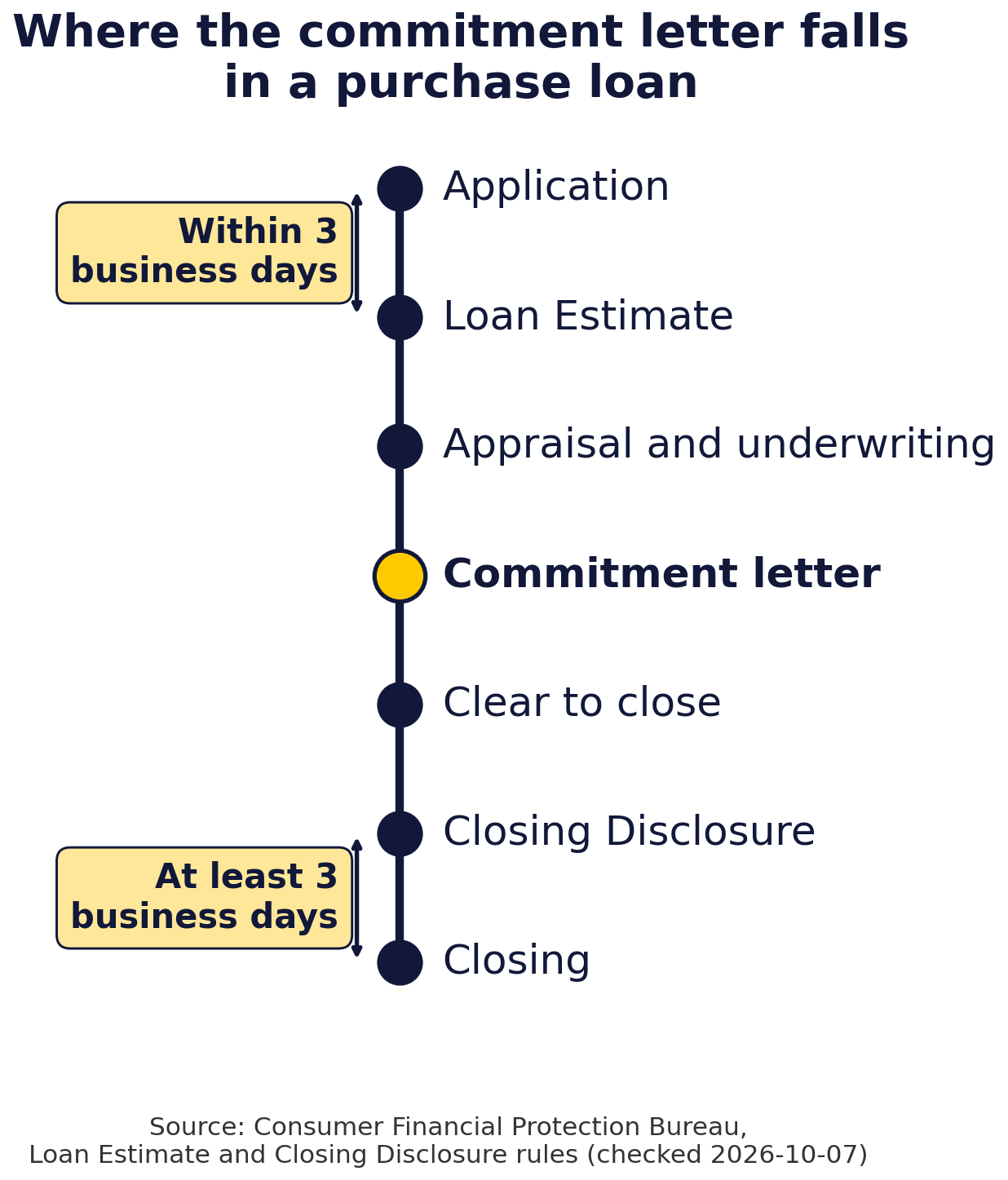
Two federal timing rules frame the process. Your lender must give you a Loan Estimate within three business days of receiving your application (CFPB, What is a Loan Estimate). At the other end, the lender must give you the Closing Disclosure at least three business days before you close (CFPB, What is a Closing Disclosure). The commitment letter sits in the middle, after the appraisal and underwriting review and before the file is cleared to close.
For a step by step view of the weeks between contract and keys, see our mortgage closing timeline for Pennsylvania buyers.
Why Sellers and Agents Care About the Commitment
Sellers want to know the deal will close. A preapproval shows a buyer is likely qualified, but it says nothing about the appraisal or the final underwriting decision. A commitment letter tells the seller and their agent that the underwriting is essentially done, which lowers the risk of a financing problem late in the deal, when the seller may already have plans built around a closing date.
The mortgage contingency deadline
Many purchase contracts include a mortgage contingency, a date by which the buyer must show the loan is approved. In practice, that proof is often the commitment letter. Missing the deadline can give the seller options under the contract, so ask your loan officer early how long your file will need and put the contingency date on both of your calendars. Your real estate agent or attorney can explain exactly what your contract says.
Conditions That Can Still Appear on the Letter
Most commitment letters are conditional. The underwriter has approved the loan structure but needs a few more items before funding. Common conditions include:
- Updated bank statements or pay stubs to confirm income and assets are still current
- Proof of homeowners insurance for the property
- An explanation and paper trail for a large deposit or transfer
- Extra self-employment documentation, such as additional tax return pages or a year to date profit and loss statement
- A final verification of employment shortly before closing
These are usually routine and clear quickly if you answer fast. The key point: a conditional commitment does not mean you are finished. It means the underwriter is waiting on a defined list before issuing the final clear to close.
Conditional versus clear to close
A conditional commitment still has open items. Clear to close means every condition is satisfied and the lender is ready to prepare closing documents. Some lenders issue the commitment and the clear to close days apart; on a clean file they can arrive close together.
Why Self-Employed Borrowers Often See More Conditions
Self-employed borrowers and 1099 contractors usually have a more layered path to a commitment than someone with a single W-2 job. Their income is evaluated through tax returns, profit and loss statements, or bank statement programs built for borrowers whose tax returns do not show their real cash flow. Underwriters may ask more questions before issuing the letter, not because anything is wrong, but because the income takes more work to verify.
This is where a lender that understands self-employed income makes a real difference. Our guides on 1099 mortgages in Pennsylvania and bank statement mortgage loans in Pennsylvania and Florida explain how that income is documented, so you can gather the right papers before underwriting asks for them.
The Underwriter’s Role
The commitment letter is the direct result of the underwriter’s review. The underwriter looks at your income, credit, assets, debts, and the property itself through the appraisal, and confirms the loan meets the rules of the program you applied for. Once that review is complete, the letter goes to you and usually to both real estate agents. Our article on what a mortgage underwriter does in Pennsylvania walks through that review and explains why some documents get requested more than once.
What Happens After You Receive the Letter
Once the conditions are satisfied, your file moves to clear to close. The lender then issues the Closing Disclosure, at least three business days before closing under the CFPB rule above, and your closing date is set. Our guide to what happens on mortgage closing day in Pennsylvania covers the signing itself.
Protect the commitment until closing
Lenders typically re-verify employment and credit close to the closing date. Between the commitment letter and closing, avoid:
- Financing a car, furniture, or anything else on new credit
- Opening new credit cards or co-signing a loan
- Changing jobs or switching from salary to commission without talking to your loan officer first
- Moving large sums of money between accounts without a paper trail
Choosing the Right Loan Before You Reach This Stage
The path to a commitment letter looks different depending on the loan you choose. Buyers weighing a 15 year term against a 30 year term are making a choice that affects the payment, total interest, and how the loan is underwritten. Our comparison of a 15 year versus 30 year mortgage in Pennsylvania can help you settle that before you are under contract, which usually means fewer conditions and less back and forth later.
Why an Owner-Operated Lender Helps at This Stage
Dynamic Funding Solutions, Inc. is an owner-operated mortgage company based in Huntingdon Valley, PA, licensed in Pennsylvania and Florida. We work directly with home buyers and homeowners on purchases and refinances, including borrowers whose income comes from self-employment or real estate investing. Because you work with the people actually handling your loan, not a call center, conditions on a commitment letter get answered by someone who already knows your file. Buyers in Abington and nearby towns can read more about working with us as an Abington mortgage broker.
Under contract and waiting on a commitment letter? Talk to Dynamic Funding Solutions.
Frequently Asked Questions
Is a commitment letter the same as clear to close?
Not always. A commitment letter often still lists conditions that must be satisfied first. Once those are cleared, the lender issues the clear to close and you move toward your closing date.
How long does it take to get a commitment letter?
It depends on the loan program, how complex the file is, and how quickly you send requested documents. Files with self-employment income or investment property often take longer because there is more for the underwriter to review.
Can a lender still deny a loan after issuing a commitment letter?
It is uncommon but possible if something material changes, such as a drop in credit score, new debt, a job change, or a problem found during final verification. That is why you should avoid big financial changes before closing.
Do I need a commitment letter to meet my mortgage contingency deadline?
In many purchase contracts, yes. The mortgage contingency usually requires proof of loan approval by a set date, and the commitment letter is the common form of that proof. Check your contract and track the date with your loan officer.
Does a commitment letter expire?
Yes. The CFPB notes that a commitment letter is valid for a certain period of time. If closing is delayed past that date, the lender may need updated documents before extending it.
If you are buying or refinancing in Pennsylvania or Florida and want a lender who will walk you through each stage, including what to expect once your commitment letter arrives, reach out to Dynamic Funding Solutions. We work with you directly from application through closing, including self-employed and investor files that need a closer look.