



Reviewed by Lena Polnet, NMLS #17225, owner of Dynamic Funding Solutions, Inc. (NMLS #17144)
Switching mortgage lenders mid purchase can feel like the right move and still go sideways if it is not handled carefully. Maybe your current lender stopped answering calls, quoted a rate that keeps changing, or told you two different things about your loan program in the same week. Buyers do switch lenders while under contract, and it can work out well with the right timing and the right questions. Done in a hurry, it can push back a closing date, cost you money, or put your deposit at risk.
Below are the mistakes that cause the most trouble when buyers change lenders after signing an agreement of sale in Pennsylvania or Florida, and what to do instead.
Mistake 1: Not Checking Your Purchase Contract Deadlines First
Your agreement of sale has dates in it that matter more than almost anything else in this decision: the mortgage contingency deadline, the closing date, and sometimes a separate financing commitment date. If you switch lenders after the mortgage contingency has already expired, you could lose the protection that lets you walk away from the deal and get your deposit back if financing falls through. A new lender starting from scratch needs time to order an appraisal, underwrite the file, and issue a clear to close.
Before you call a new loan officer, read your contract and know exactly how many days you have left. If the timeline is tight, ask your real estate agent or attorney whether an extension is realistic before you commit to the switch. Our guide to what a mortgage commitment letter is and why it matters explains how that letter usually ties to the contingency date.
Mistake 2: Assuming a Lower Advertised Rate Will Apply to You
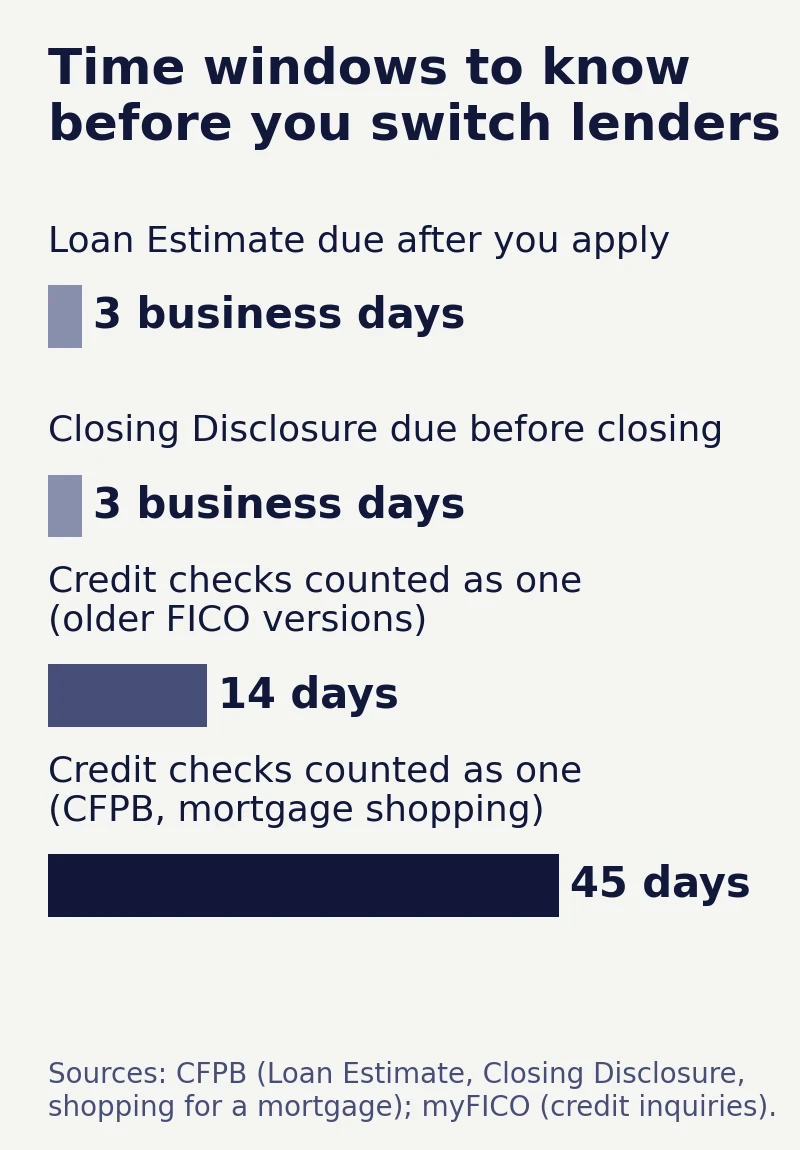
A rate you see online or hear over the phone is not a locked, guaranteed number. The Consumer Financial Protection Bureau requires a lender to give you a Loan Estimate within three business days of receiving your application (CFPB, What is a Loan Estimate). That form, based on your real credit, income, and property, is what you should compare.
Buyers sometimes switch lenders chasing a rate that sounded better, then learn the quote assumed a higher credit score, a smaller loan amount, or a different property type. Ask the new lender for a written Loan Estimate on your actual numbers and compare it side by side with the one your current lender issued.
Mistake 3: Restarting the Loan Without Confirming the New Timeline
Every mortgage goes through an appraisal and underwriting, whoever the lender is. When you switch mid purchase, that work does not carry over automatically. Some documents can be reused if both lenders cooperate, but appraisals often need to be reordered and underwriting starts fresh under the new company’s process.
Ask directly: how many business days does the new lender need to get from application to clear to close, and does that fit inside what is left in your contract? A vague answer is a warning sign. Our mortgage closing timeline for Pennsylvania buyers shows each stage a new lender has to repeat.
The federal timing rules still apply after a switch
Switching does not shorten the required disclosure windows. The new lender owes you a fresh Loan Estimate, and the Closing Disclosure must reach you at least three business days before you close (CFPB, What is a Closing Disclosure). Build both into any new timeline.
Mistake 4: Not Understanding Why the First Lender Was a Problem
Be honest about what actually went wrong before assuming a new lender will be different. Was it slow communication? A program that did not fit, such as a self-employed borrower being run through a process built for W-2 income? A rate that kept moving every time you asked a question? Some problems come from one loan officer, and some come from how the company is structured. At a large call center lender, your file may pass between several processors during the deal, which is often where the communication breaks down.
Knowing the real cause helps you judge whether the next lender will fix it. Our explanation of the differences between a bank, a mortgage broker, and a direct lender is a good place to start if you are not sure what kind of company you are working with.
Mistake 5: Forgetting That Your Credit Gets Pulled Again
A new lender will run a new credit check. According to the CFPB, multiple credit checks from mortgage lenders within a 45 day window are recorded as a single inquiry (CFPB, Will shopping for a mortgage hurt my credit). Older FICO scoring versions use a 14 day span instead, and each lender chooses which version it uses (myFICO, Credit checks and inquiries). If your first credit pull was weeks ago, the new one may count separately.
More important: do not open new credit, finance a car, or make large purchases while you are mid switch. Any of those can change your debt to income ratio or credit profile enough to affect approval, and a lender verifying everything from scratch leaves less room for surprises.
Mistake 6: Overlooking Appraisal and Fee Duplication
An appraisal ordered and paid for through your original lender does not transfer to a new one in every case. Some lenders can use an existing appraisal if it is recent and meets their investor guidelines, but many require a new one, which means paying again. Other upfront costs can repeat too.
Before you commit, ask the new lender which fees you have already paid will need to be paid again, and get the answer in writing. That cost belongs in your decision, especially close to closing.
Mistake 7: Switching Too Close to Closing Without a Backup Plan
The riskiest time to switch is in the final days before a scheduled closing. By then most of the underwriting with the original lender is likely done, and a new lender starting from zero may not be able to hit the same date. If the seller will not extend, you could face a breach of contract or a lost deposit. If you are this close and still thinking about switching, talk to your agent about the seller’s flexibility before you act, not after.
Mistake 8: Not Asking About Loan Program Fit
Sometimes the real issue is the loan program, not the lender. Self-employed borrowers and real estate investors often run into trouble with lenders whose systems are built around W-2 income and standard owner occupied purchases. If your original lender struggled to qualify you on bank statements, or had no flexible option for an investment property, switching to a lender with the same setup may not fix anything.
Ask upfront whether the new lender works with self-employed and 1099 files regularly. Our guide to how income is evaluated for 1099 contractors and self-employed borrowers is worth reading if that is part of why you are considering the move.
Mistake 9: Ignoring Your Rate Lock
If your original lender locked your rate, that lock stays with that lender. The new lender sets a new lock at whatever rate is available that day. Rates move, so you could end up better off, worse off, or about the same. The CFPB suggests asking how long a lock lasts, what happens if closing is delayed and the lock expires, and whether anything could still change the rate after you lock (CFPB, What is a rate lock).
Ask the new lender when they recommend locking given your closing date, and read our breakdown of when to lock a mortgage rate in Pennsylvania before that conversation.
Mistake 10: Not Confirming the New Lender Is Licensed Where the Property Is
A lender has to be licensed in the state where the home is located, and not every lender is licensed in both Pennsylvania and Florida. Ask for the company’s NMLS number and look it up on NMLS Consumer Access before you send documents. Dynamic Funding Solutions, Inc. is licensed in Pennsylvania and Florida, closes loans remotely with electronic signatures, and works with buyers across both states, including nearby towns like Levittown, Langhorne, Southampton, and Abington.
Mistake 11: Committing Without Everything in Writing
The biggest mistake in a lender switch is deciding on the strength of a phone call. Before you move forward, get a written Loan Estimate, a written timeline to closing, and written confirmation of which fees are reused and which repeat. Verbal promises about rate, timing, and cost are not binding, which is exactly why federal rules require loan terms to be disclosed on standard forms.
Why an Owner-Operated Lender Helps in a Mid Purchase Switch
Dynamic Funding Solutions, Inc. is an owner-operated mortgage company based in Huntingdon Valley, PA, licensed in Pennsylvania and Florida. We work with home buyers, homeowners, and real estate investors, including borrowers whose income comes from self-employment or investing. Because you work directly with the people handling your loan, not a call center, questions about your contract dates and conditions get answered by someone who already knows your file. That matters most when the clock is running. If you are still comparing options, our list of questions to ask a mortgage lender before you apply works just as well for a second lender as a first.
Thinking about switching lenders mid purchase? Talk to Dynamic Funding Solutions before you decide.
Frequently Asked Questions
Can I switch mortgage lenders after I sign a purchase agreement?
Yes. Buyers switch lenders after signing an agreement of sale fairly often. Check your mortgage contingency deadline and closing date first, because those dates do not change when you change lenders.
Will switching lenders delay my closing date?
It can. A new lender has to restart underwriting, may need a new appraisal, and must issue its own Loan Estimate and Closing Disclosure. Whether closing moves depends on how much time is left in your contract and how quickly the new lender can work.
Do I lose money if I switch lenders mid purchase?
You may pay for some items again, such as an appraisal, if they do not transfer. Ask the new lender for a written list of which costs are reused and which repeat before you commit.
Does switching lenders hurt my credit score?
The new lender will check your credit. The CFPB says mortgage credit checks within a 45 day window are recorded as a single inquiry, though older FICO versions use a 14 day span. Avoid any other new credit while you switch.
Does my rate lock transfer to the new lender?
No. A rate lock is with the lender that issued it. The new lender sets a new lock at the rate available when you lock, which may be higher, lower, or the same.
If you are considering switching lenders mid purchase and want a clear read on whether your contract dates still work, call Dynamic Funding Solutions at (215) 364-7171. We will look at your actual dates and loan scenario before you make any commitment.